Plot:
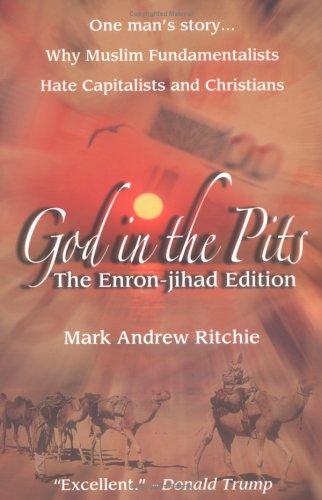
(From the back cover)- Mark Andrew Ritchie has been quoted, "Islamic people are the kindest, most loving, most hospitable people in the world." Then he claims that when he saw the second plane hit the WTC, he knew that Muslims had finally brought jihad to America. Is he credible?
Ritchie thinks America has a blind spot- spiritual engagement. Nineteen hijackers traveled complex spiritual roads that came to a fateful end. But we avoid spiritual discussions... too personal. His mother served the poor and was attacked b a suicide bomber. His father served the poor and died in a mysterious accident. In remote Herat, Afghanistan, Ritchie encounters a mute child and is forced to review his own life ambition- buy low and sell high. From tiny Oregon logging town to Kandahar, he struggles with life, death, and the distractions of the money pits at the Chicago Board of Trade.
My Initial Expectation:Ritchie thinks America has a blind spot- spiritual engagement. Nineteen hijackers traveled complex spiritual roads that came to a fateful end. But we avoid spiritual discussions... too personal. His mother served the poor and was attacked b a suicide bomber. His father served the poor and died in a mysterious accident. In remote Herat, Afghanistan, Ritchie encounters a mute child and is forced to review his own life ambition- buy low and sell high. From tiny Oregon logging town to Kandahar, he struggles with life, death, and the distractions of the money pits at the Chicago Board of Trade.
My boyfriend, Ryan, received this book from a client and loved it. His dream is to just trade the commodities market on his own and since that's how Ritchie has made his money, he was really excited about this book. He asked me to read it so I did. I went into the book thinking that it would be a story about how he managed to make money through commodities even through the Enron scandal and 9/11.
My Thoughts:
Um, Enron? Jihad? Ritchie mentions the jihad thing briefly in the very beginning of the book but doesn't mention Enron until the epilogue and even then only spends a few sentences on the subject. I think the best way to approach this is by going through the synopsis section by section.
1. Mark Andrew Ritchie has been quoted, "Islamic people are the kindest, most loving, most hospitable people in the world." Yeah, he does ramble about something like this in the epilogue. He says that he was going through his email one day and came across on that said something about "See what young Asian girls can do with farm animals." He said that the racism of the subject bothered him. Really?! THAT'S what bothered you?! How about the fact that they're underage or doing it with animals?! He then proceeds to say that Muslims look at stuff like that and think that those girls could be their female relatives. He claims that there's a slow burn there that kindles the hatred towards Americans and eventually turns towards an all out hatred which prompts them to commit acts of terrorism. His transition from the porn thing to terrorism is choppy and not very smooth which is a common theme throughout the book.
2. Then he claims that when he saw the second plane hit the WTC, he knew that Muslims had finally brought jihad to America. Is he credible? I don't think he is in this regard. He doesn't have much evidence other than common knowledge for this line of thinking so I'm not sure that I really trust his opinion of this subject. He spent several (from what I can tell it's about 4-5) years of his childhood in Afghanistan so he's more exposed to Muslims than I am but that's really all he claims as expertise in the subject.
3. Ritchie thinks America has a blind spot- spiritual engagement. Nineteen hijackers traveled complex spiritual roads that came to a fateful end. But we avoid spiritual discussions... too personal. He talks a lot about this through the book. Not necessarily about the hijackers but about Americans not talking about spiritual issues unless it's to discredit the biblical solutions. This is really what the book is about- Ritchie's quest for biblical truth. It was definitely a struggle for him because to question Christianity could get one in a lot of trouble with church authority. This is a good book for someone who might be questioning if God is real and what his role in our everyday lives is.
4. His mother served the poor and was attacked b a suicide bomber. His father served the poor and died in a mysterious accident. In remote Herat, Afghanistan, Ritchie encounters a mute child and is forced to review his own life ambition- buy low and sell high. The circumstances regarding Ritchie's return to Herat is tragic and I really felt for him. This book started out really well in the fact that the things he saw in Herat prompted memories of growing up and his relationship with his wife. But this only lasted about 2/3 through the book then his transitions between chapters became choppy again. His life ambition didn't really seem to be buy low, sell high. I think they just needed some industry lingo to insert into the summary. HIs life ambition seemed to be more like "figure out this God thing and make some money in the meantime."
5. From tiny Oregon logging town to Kandahar, he struggles with life, death, and the distractions of the money pits at the Chicago Board of Trade. Ritchie doesn't really mention the Chicago Board of Trade much other than to mention how he got into commodities and that he made and lost a lot of money there. It was a tad disappointing that the story of his trading played such a small part in the story. With a name like "God in the Pits," I would have thought the story would have been about how he managed to stay away from the corruption of greed so prevalent in any aspect of the finance/business industry. I was actually excited to hear how someone had succeeded where so many have failed but, alas, that was not to be.
I think that this book was great in some aspects and needs some work in others. I think a start would be by retitling it and maybe having a more relevant subtitle should there be a fourth edition.
Ratings:
(See rating chart on right)
Overall Concept-2
Plot-2
Loveability of Characters-1
Cover Appeal-3
Overall Rating-2
Buy on Amazon.com